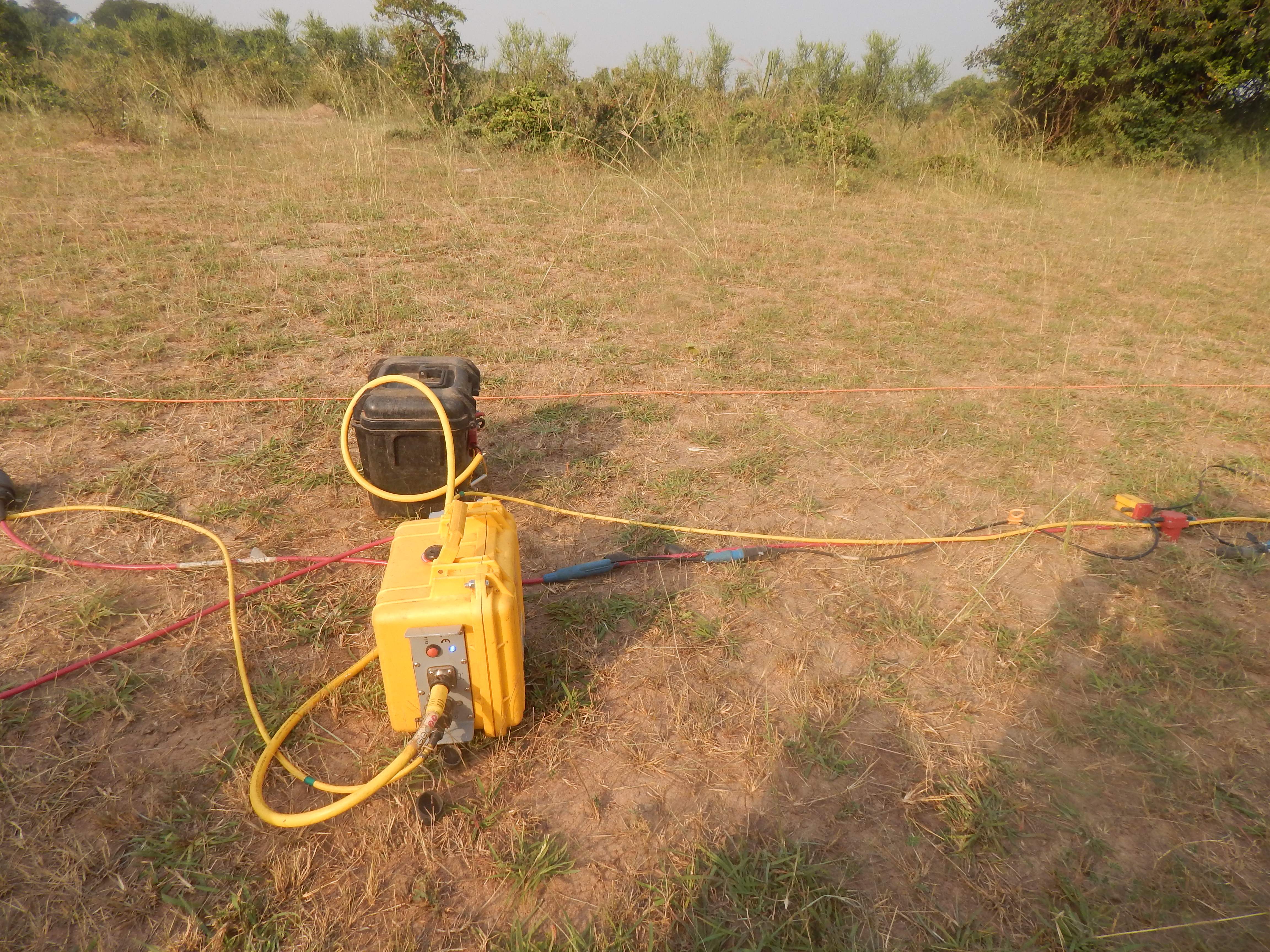
If you are designing a dam in East Africa, the geophysical method you choose for the foundation investigation is a decision with real money attached to it. Drill too blindly and you miss a weathering trough under the abutment; specify the wrong geophysical method and you image the wrong physical property. This is a practical comparison of the two methods we are most often asked to choose between — electrical resistivity tomography (ERT) and seismic refraction — for dam foundation studies.
The core difference: what each method actually measures
Seismic refraction measures P-wave velocity (Vp) — how fast a compressional wave travels through the ground. Vp is governed by rock stiffness (bulk and shear modulus) and density, which is why it correlates so well with rock-mass quality, rippability, and depth to competent bedrock.
ERT measures electrical resistivity — how strongly the ground resists the flow of an injected current. Resistivity is governed by water content, pore-fluid chemistry, clay content, and porosity. It is the method of choice for groundwater, contamination, and clay geometry.
For a dam foundation, the engineer's first questions are almost always about rock quality and depth — which is Vp's home turf. But the second-order questions — is there a permeable layer, a clay seam, or a saturated zone under the axis — pull resistivity into the frame.
When seismic refraction is the right primary method
For most dam feasibility and preliminary-design stages in East Africa, refraction is our lead method because:
- It gives Vp directly, which converts to rock-mass class and rippability without ambiguity.
- It resolves depth to competent bedrock across the full axis, which is the single number the designer needs first.
- It works well on the moderately weathered crystalline basement that underlies most of our dam sites in Uganda, Rwanda and Burundi.
The honest limitation: refraction cannot detect a velocity inversion — a low-velocity layer hidden beneath a higher-velocity one. If a soft, saturated clay horizon sits under stiffer saprolite, refraction will mask it. On a dam foundation that is exactly the feature you cannot afford to miss, because it is the one that controls seepage and uplift.
When ERT is the right primary method
ERT takes the lead when the dam's risk profile is dominated by fluid-related questions rather than rock-quality questions:
- Seepage and grouting design. Resistivity maps permeable zones, clay seams, and saturated pathways that control under-seepage beneath a dam.
- Clay foundations. Where the foundation is a clay-rich saprolite or laterite, ERT images the geometry and saturation of the clay body that refraction will struggle to differentiate.
- Contaminant or saltwater interaction with reservoir water.
The honest limitation: ERT needs good electrode-to-ground contact, which is hard on dry gravel, hardpan, or rock outcrops — exactly the conditions where refraction is easiest. And a conductive clay overburden will suppress the signal from any deeper resistive target.
The case for running both
On our recent dam programmes (Mwogo/Rukarara in Rwanda, Arua in Uganda) we have run both methods on the same spread, and the combination is consistently more defensible than either alone. Refraction gives the rock-quality model; ERT gives the fluid-and-clay model; together they bracket the two failure modes — bearing capacity/seismic and seepage/uplift — that a dam designer has to close. The incremental cost of adding ERT to an existing seismic crew is modest, because the site access, clearing, and mobilisation are already paid for.
A simple decision rule
- If the primary question is "how deep is the rock and how good is it?" → lead with seismic refraction.
- If the primary question is "where is the water, the clay, the seepage path?" → lead with ERT.
- If the dam is more than 10 m high or the geology is variable → run both, and calibrate with 2–3 boreholes.
FAQ
Q: Can ERT give me a rock-mass quality number?
A: Indirectly and weakly. Resistivity correlates with fracturing and water content, but it is a poor proxy for stiffness. If you need a rock-mass class for design, use Vp from refraction.
Q: We only have budget for one method — which one?
A: For a concrete or RCC dam, refraction. For an earthfill dam on a clay foundation where seepage control is the design driver, ERT. Then spend the saved budget on a calibration borehole at the geophysically-flagged critical point.
Q: Does MASW replace refraction for dam sites?
A: It complements rather than replaces. MASW gives Vs (shear-wave velocity) and the site class for seismic design, which refraction does not. But refraction gives the sharper bedrock boundary. For dams in seismic zones we run refraction + MASW as the seismic pair, and add ERT if seepage is a concern.