In October 2025, Nairobi-based Octavia Carbon commissioned Project Hummingbird — the first commercial direct air capture (DAC) facility on the African continent. For those of us working in East African geoscience, the location is no accident: the Kenyan stretch of the Rift Valley offers two of the things DAC needs most, abundant low-carbon heat and reactive basaltic rock for permanent CO₂ mineralisation.
Why the Rift Valley works for DAC
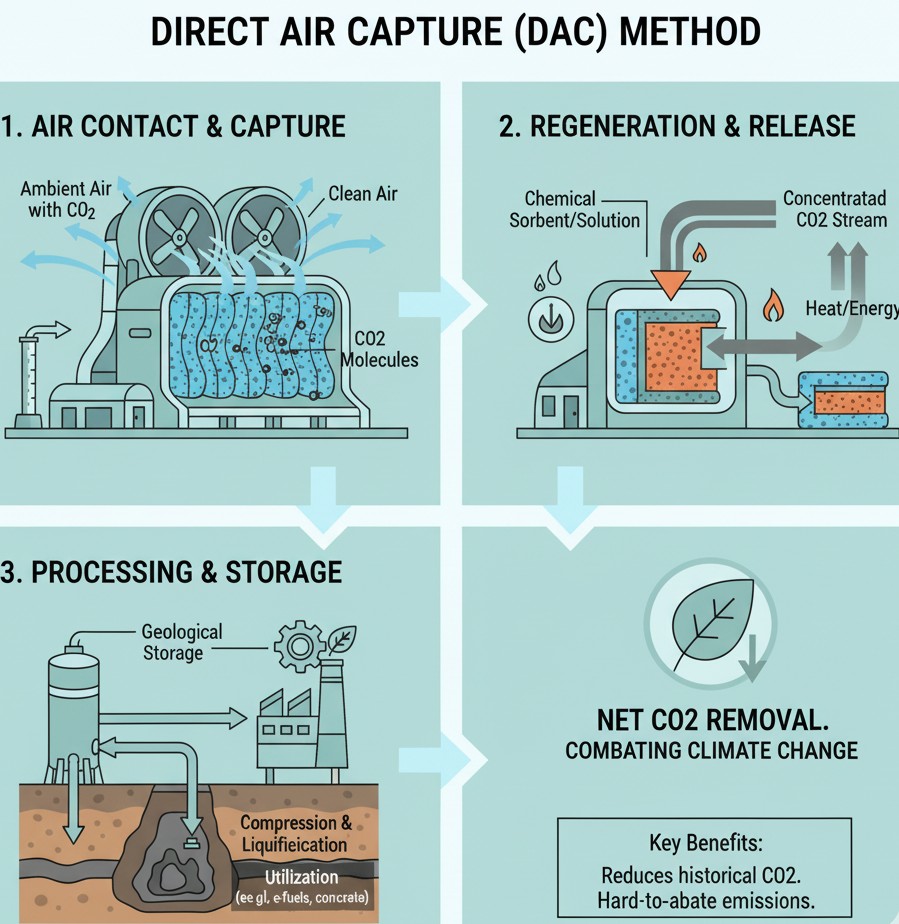
DAC is energy-hungry. The sorbent regeneration step demands temperatures in the 80–900 °C range, which is ruinously expensive if sourced from fossil power. Kenya's geothermal fields — Olkaria and the emerging Menengai complex — can supply that heat directly, without a combustion step. The second piece of the puzzle is storage: Iceland's Carbfix process has shown that CO₂ dissolved in water and injected into basalt mineralises to solid carbonate in under two years. The Rift's flood basalts are broadly comparable.
What it means for geoscience in the region
From our perspective at Georesolve, three things stand out:
- Subsurface characterisation is back on the critical path. Siting a DAC-plus-storage hub requires the same subsurface toolkit we use for geothermal exploration — magnetics, MT/ERT, and structural mapping of fault-controlled fluid pathways.
- East Africa can plausibly supply 10–20% of future removal credits. The RMI analysis suggests the region's combination of geothermal and basalt could underwrite a meaningful share of global DAC capacity by 2035.
- Local capability is growing. Octavia Carbon's locally-trained engineering team is proof that the human capital for these projects can be built in-region.
A note of caution
DAC is not a substitute for emissions reductions, and the economics today are north of $400 per tonne. But the learning curve is real, and East Africa's geological endowment gives it a structural advantage that is worth understanding now rather than later.
FAQ
Q: Is DAC commercially viable in East Africa today?
A: Not at scale without offtake agreements and carbon finance. Project Hummingbird is a first-of-a-kind plant; costs will fall as the local supply chain matures.
Q: What geoscience work does a DAC+storage site need?
A: Geothermal resource mapping (heat flow, permeability), structural geology of the target basalt, injectivity testing, and baseline groundwater monitoring — essentially a combined geophysical and geotechnical programme.
Source: RMI — The opportunity for direct air capture in Africa