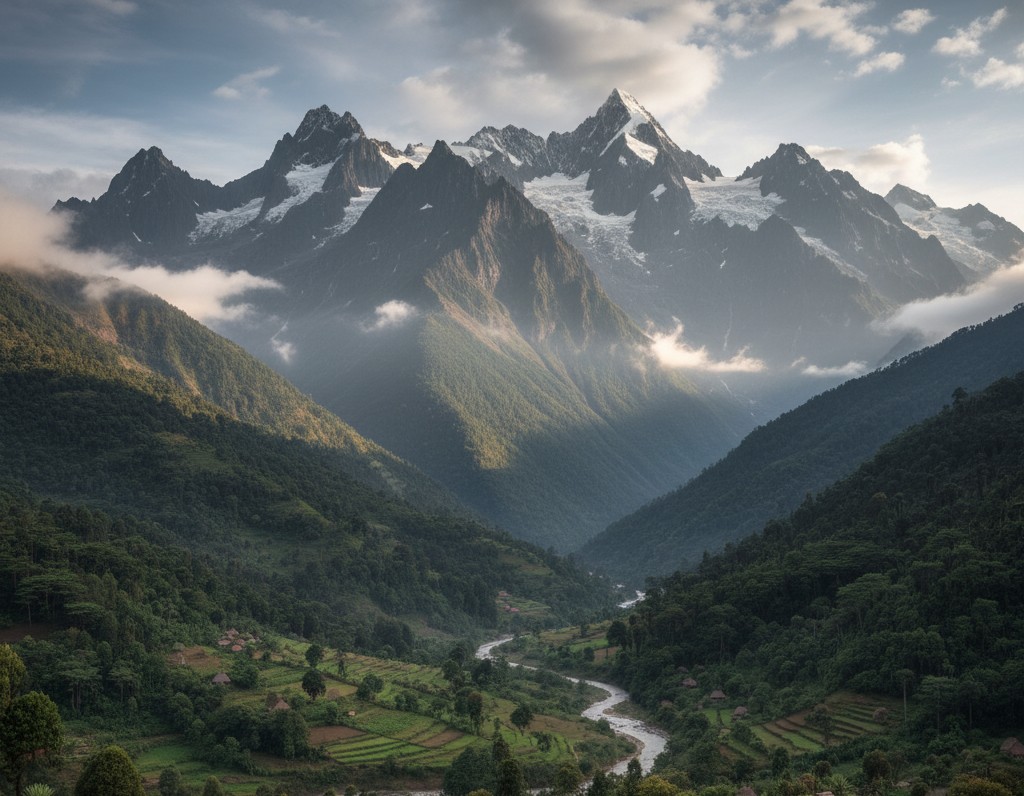
In June 2025, a partnership between Ugandan communities in Kilembe village and researchers from Penn State planted 1,500 indigenous trees on the slopes of the Rwenzori Mountains. It is a modest number, but the project is a useful worked example of how nature-based adaptation and slope-stability geoscience should be designed together rather than in isolation.
The hazard
The Rwenzori range's eastern flanks have experienced a marked increase in rainfall-triggered landslides and debris flows over the past decade. Kilembe, sitting at the mouth of a steep valley that channels storm runoff, has been hit repeatedly. The underlying geology — deeply weathered schist and gneiss overlying bedrock — produces a residual soil that loses cohesive strength rapidly when saturated.
Why trees alone are not enough
Root systems improve apparent cohesion in the shallow vadose zone, and evapotranspiration reduces pore-water pressure. But on slopes where the failure surface sits at 3–6 m depth — below the rooting zone of most replanted species — vegetation alone will not arrest a translational slide. That is where geotechnical and geophysical investigation comes in:
- Seismic refraction maps the depth to intact bedrock and identifies low-velocity, saturated residual soil.
- ERT images the water table and any perched aquifers that drive pore-pressure spikes.
- Slope-stability analysis then combines these inputs with shear-strength parameters to flag which slopes are beyond the reach of bioengineering and need structural intervention.
The integrated approach
What the Kilembe project gets right is sequencing: community planting on the shallow, stable upper slopes while geotechnical assessment identifies the deeper-seated hazard zones that will require drainage or retaining structures. Reforestation is necessary but not sufficient; without the subsurface picture you risk planting trees on slopes that will simply slide out from under them.
FAQ
Q: How deep do tree roots stabilise a slope?
A: Most replanted indigenous species in East Africa root to 1–1.5 m. They meaningfully reduce shallow (≤1 m) translational failures but have limited effect on deeper slides.
Q: When should you call a geotechnical investigation before replanting?
A: Whenever the slope exceeds ~25°, shows tension cracks or historical scarps, or sits above infrastructure. A single seismic refraction line is a cheap insurance policy against planting the wrong solution.
Source: Penn State — Uganda community collaboration targets climate hazards